Geometry
22 units
-
Computational geometry problems, many taken from the tail end of the AIME. At the border of computational contests and olympiads.
-
This is a unit about building "diagram intuition": being able to take a geometry diagram (which may be good or bad) and trying to get a sense of which claims should or shouldn't be true. This is definitely one of the longer geometry units.
-
Barycentric coordinates in olympiad geometry. A follow-up to Chapter 7 of EGMO.
-
Formerly part of "American Geo". This is somewhere between Config Geo and Elem Geo. A lot of these problems involve figuring out what certain points are, adding in new points that were not that already, and altogether slowly piecing together a master diagram that reveals the depth of a certain picture.
-
Complex numbers in olympiad geometry. A follow-up to Chapter 6 of EGMO.
-
Formerly known as "American Geo". This is a unit on geometry problems with a highly traditional or synthetic flavor, for example USAMO 2016/3 and USAMO 2017/3. These sorts of problems were popular on the USA olympiads and team selection tests around 2016 and it is totally not my fault. These particular ones tend to use common or standard configurations as a base and build on top of them, as opposed to starting afresh.
-
A mostly-for-fun unit on problems involving constructions. In addition to classical ruler-compass constructions, you may get to use exotic tools that you've never heard of! Includes double-sided rulers, marked rulers, cyclos, circumcircle compasses, splitters, perpendicular bisector rulers, isogonal conjugate finders, and more.
-
A unit featuring easy to medium geometry problems which can be solved using only the most basic tools: angle chasing, power of a point, homothety. It can be thought of as a follow-up to Part I of EGMO.
-
A challenging geometry unit to conclude the year, with difficult problems reviewing everything that has appeared earlier.
-
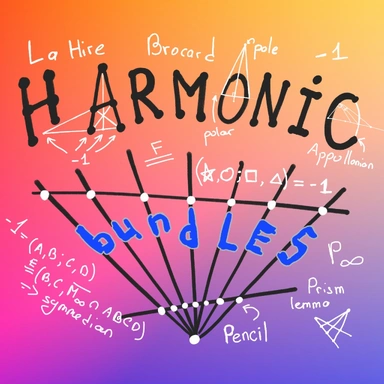
Your friendly projective geometry unit. Harmonic bundles, poles and polars, and so on. A follow-up to Chapter 9 of EGMO.
-
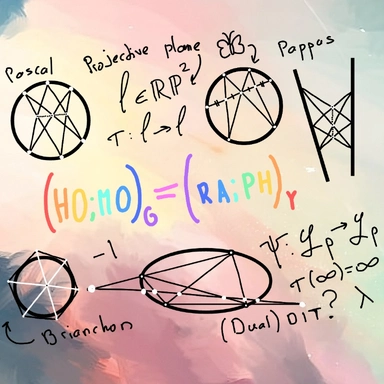
A less friendly and more abstract projective geometry unit, with an emphasis on projective transformations. Most of the theorems will be stated with respect to an arbitrary conic rather than a circle. Expect lots of Pascal. Includes Desargues involution theorem (DIT) and its dual (DDIT).
-
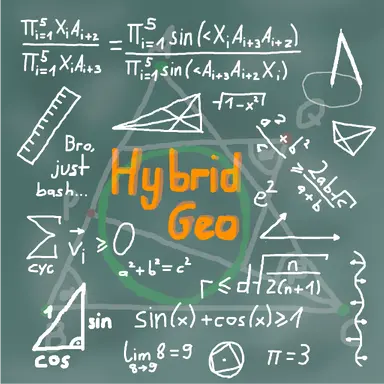
Grab-bag of geometry problems that feature some algebra, combinatorics, or number theory. As examples, this includes geometric inequalities, combinatorial geometry, and problems involving integer distances or lattice points.
-
A silly (but difficult) unit on the theory of rectangular circumhyperbolas and the Poncelet point. For fun, if you really like hardcore projective geometry.
-
A harder follow-up unit to chapters 8 and 10 of EGMO.
-
Inversion in olympiad geometry, following up chapter 8 of EGMO.
-
This unit revolves around two particular techniques: linearity of a difference of power of a point and the forgotten coaxiality lemma. This is used to compare powers of a point with respect to two different circles, particularly showing they are equal.
-
A technique involving animating points and considering resulting projective maps. This lecture was contributed by Anant Mudgal.
-
Spiral similarity and Miquel points, following up chapter 10 of EGMO.
-
A more difficult version of the barycentric coordinates unit.
-
A more difficult version of the complex numbers unit.
-
The trig-bash unit. Several traditional-style geometry problems that are meant to be solved by chasing lengths and ratios, with the aid of trigonometric techniques.
-
Those weird geometry problems that involve pentagons and hexagons and whatnot (see USAMO 2011/3 for example). Careful use of complex numbers and counting degrees of freedom are important for this unit.