Number Theory
14 units
-
Problems that involve asymptotic calculations in number theory, featuring some multiplicative number theory. Convolution method, and generally problems that require more technical estimates.
-
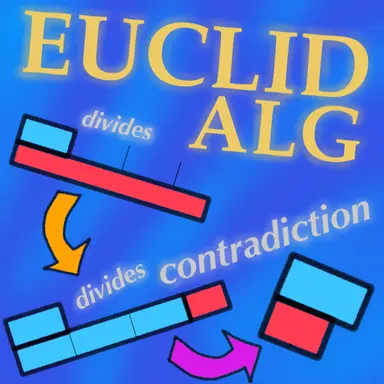
A unit about the idea that if $d$ divides $a$ and $b$, then $d$ divides any linear combination of $a$ and $b$. This intuition underlies Bezout's lemma, the Euclidean algorithm, and the division algorithm, as well as a technique which I privately call remainder bounding. One very good example of a problem of this feeling is SL 2016 N4 (sort of the crown example of remainder bounding).
-
Expressions of the form $a^n \pm 1$, the bread and butter of olympiad number theory. Mods and orders, Fermat's Christmas theorem, lifting the exponent.
-

Heavy machinery in number theory: Vieta jumping, quadratic reciprocity, and some big-name theorems you may or may not have heard of.
-
A theoretical unit on the algebra and number theory of polynomials over $\mathbb Z$, bordering into some algebraic number theory and Galois theory. Algebraic integers and irreducible polynomials feature prominently in this unit. The number theory in this unit goes deeper than that used in the Irreducible unit.
-
Miscellaneous number theory problems that didn't fit well in other units.
-
One of two beginner units in number theory focusing on modular arithmetic. Emphasis on basic proof-based problems, starting with simple Diophantine equations that can be solved by taking moduluses and factoring. The two Modular Arithmetic units can be done in either order.
-
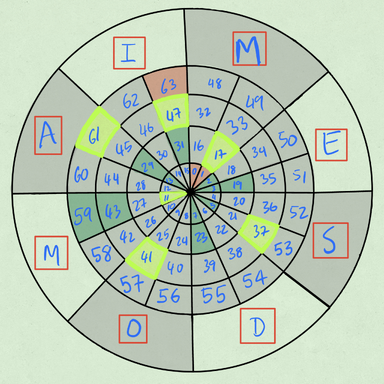
One of two beginner units in number theory focusing on modular arithmetic. Emphasis on concrete calculation in problems which ultimately ask for a numerical answer. The two Modular Arithmetic units can be done in either order.
-
A challenging number theory unit to conclude the year, with difficult problems reviewing everything that has appeared earlier.
-
Construction problems in number theory. In some ways it's like the free unit because you get to make some decisions, but in other ways Z has a lot of structure that you might know things about, and you'll have to balance these two intuitions.
-
Orders modulo a prime, at the border of AIME and USA(J)MO but leaning a lot more towards the latter. Intended as an introduction into olympiad number theory.
-
The use of $\nu_p$ in handling olympiad problems.
-
Using size as a way to handle number theory conditions, for example taking sufficiently large primes. On the border between olympiad algebra and olympiad number theory.
-
Number theory practice for experts, combining problems from Exp and Heavy NT as well as some other sources.